 Zoning vs. Comprehensive Plan: The Difference That Matters
Many homeowners use "zoning" and "comprehensive plan" interchangeably. They are not the same thing, and the distinction is the entire point, because it changes when a homeowner can effectively shape development in their community.
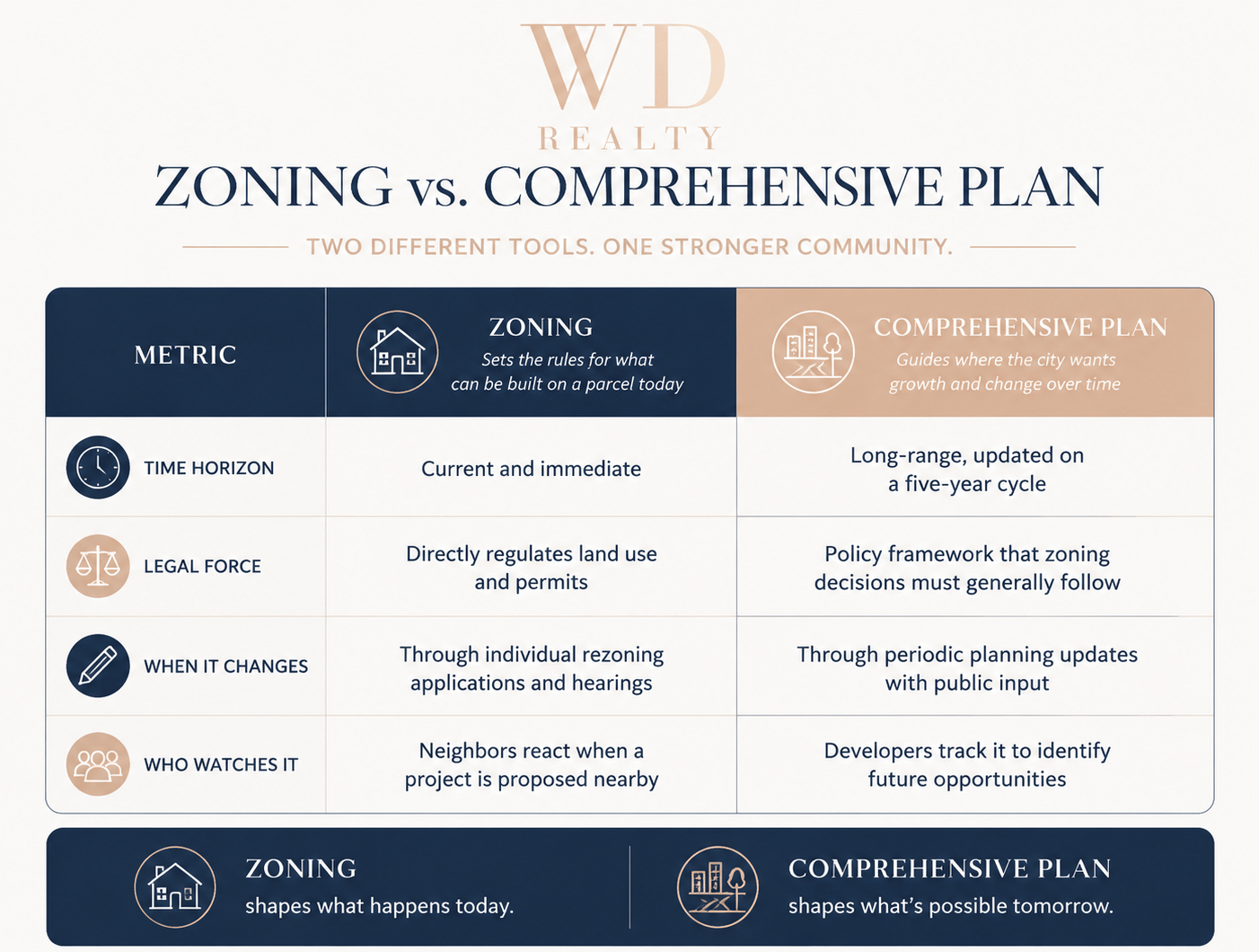
Why the Plan Outranks Zoning
Zoning is the rulebook for what can be built on a specific piece of land right now. The comprehensive plan is the larger map of where the city intends growth to occur. The critical connection is that zoning decisions are supposed to follow the comprehensive plan. When a developer applies to rezone a property, one of the first questions the city and planning commission ask is whether the request aligns with the comprehensive plan. If the plan already designates an area for higher-density or commercial use, a rezoning request that matches it is far more likely to be approved, often before nearby residents are even aware a change is being considered. I have watched that exact sequence play out, and it is why I tell clients the plan is the document that really matters.
Why Developers Watch the Plan and Homeowners Don't
Developers and land investors monitor comprehensive plans because the document signals where future growth will be permitted and encouraged. The designations on the plan's future land use map influence where they can profitably acquire and develop land. Most homeowners, by contrast, never engage with the comprehensive plan and only get involved when a specific project appears near their property, typically at a rezoning hearing.
The problem with waiting for the rezoning hearing is timing. By the time a project reaches a public hearing, the underlying policy decision, whether that area is designated for that type of growth, may have been made years earlier in the comprehensive plan. A rezoning that conforms to the adopted plan is difficult to oppose at the hearing stage, because the city has already established through the plan that the area is intended for that kind of development. In my experience, this is the single most misunderstood thing about how growth happens, and understanding it is what separates homeowners who shape their neighborhoods from those who merely react to them.
Perry's First City-Specific Plan: What's New in 2026
According to 13WMAZ and Perry Today reporting from March 30, 2026, the City of Perry began creating its own comprehensive plan rather than continuing to share one jointly with Houston County, Warner Robins, and Centerville. Perry has maintained a comprehensive plan since 1989, but always as part of a joint county-cities document. Community Development Director Joe Duffy explained that the City Council felt it was time for Perry to have its own city-specific plan, tailored to what Perry residents see as their vision for the future.
Duffy emphasized that the city had not predetermined the outcome, describing the effort as a transparent public process and characterizing city staff as ambassadors for a community-driven plan rather than authors of a predetermined one. Georgia requires nine elements in a comprehensive plan, spanning transportation, housing, quality of life, and community work programs, among others. The city's own request for proposals describes the effort as a strategy for the next 20 years, updated on a five-year cycle, and completing it keeps Perry eligible for certain state funding. The plan is expected to be completed by February 2027, moving through five phases, with resident input gathered along the way.
How Homeowners Can Use the Input Window
The current planning process is a genuine, time-limited opportunity for Perry homeowners to influence the future land use map and policy priorities of their city. The City of Perry is gathering resident input through an online survey on the city website and through a series of public stakeholder sessions. The city scheduled Comprehensive Plan Stakeholder Sessions at the Perry Events Center (1121 Macon Road) from 5:00 to 7:00 p.m. on the following dates: Economic Development on June 17, Housing on June 21, Future Growth and Land Use on June 24, and Civic Life and City Services on June 29. Because the plan is not yet finalized, input provided during these sessions and through the survey can shape the designations and priorities that guide development decisions going forward.
There is also an infrastructure angle worth knowing: the city's planning documents note that a second wastewater treatment facility beginning operations in 2026 opens thousands of unincorporated acres on the east side of Perry to potential annexation and development, which the comprehensive plan and future land use map will help guide. My advice to any homeowner with a concern, whether it is preserving the character of an area, protecting against incompatible density, or prioritizing green space, is the same: raise it during the planning process. Completing the city survey, attending a stakeholder session, and reviewing draft materials as they are released are far more effective than waiting to oppose an individual project later, when the plan has already cleared the path for it.
Frequently Asked Questions: Perry Comprehensive Plan and Zoning
Q: What is a comprehensive plan in Perry, Georgia?
A: A comprehensive plan is a long-range policy document that guides where and how a city wants to grow over time. In Perry, the plan sets a long-range vision and is updated on a five-year cycle, addressing elements such as transportation, housing, and quality of life. Georgia requires local governments to maintain a comprehensive plan, and it makes the city eligible for certain state funding. Perry began creating its first city-specific plan in March 2026, led by Community Development Director Joe Duffy.
Q: What is the difference between zoning and a comprehensive plan?
A: Zoning sets the rules for what can be built on a specific parcel today and directly regulates land use. A comprehensive plan is a longer-range policy framework guiding where the city wants growth to occur. Zoning decisions are supposed to align with the comprehensive plan, which means the plan effectively shapes which future rezonings will be approved.
Q: Why does the comprehensive plan matter to homeowners?
A: The comprehensive plan determines where the city encourages future growth, density, and commercial development. Because rezoning decisions must generally conform to the plan, it strongly influences what can eventually be built near a homeowner's property. Engaging during the planning process is the most effective way for a homeowner to influence future development near their home.
Q: When is the best time to influence development near my home?
A: The most effective time is during the comprehensive planning process, while the future land use map and policies are still being written. By the time an individual project reaches a rezoning hearing, the underlying policy decision may already have been made in the plan, making the project difficult to oppose if it conforms to the adopted plan.
Q: When will Perry's comprehensive plan be finished?
A: The City of Perry began the process in March 2026 and expects to complete the plan by approximately February 2027. Resident input is being gathered during the months leading up to completion through an online survey and public stakeholder sessions.
Q: Why is Perry creating its own comprehensive plan now?
A: Perry has maintained a comprehensive plan since 1989 but previously shared one jointly with Houston County, Warner Robins, and Centerville. According to Community Development Director Joe Duffy, the City Council decided it was time for Perry to have its own city-specific plan tailored to the vision of Perry residents.
Q: How can I give input on Perry's comprehensive plan?
A: The City of Perry is collecting resident input through an online survey on the city website and through Comprehensive Plan Stakeholder Sessions at the Perry Events Center (1121 Macon Road), held 5:00 to 7:00 p.m. on June 17 (Economic Development), June 21 (Housing), June 24 (Future Growth and Land Use), and June 29 (Civic Life and City Services). Homeowners can also review draft materials as they are released before the plan is finalized.
Q: What are the nine elements of a Georgia comprehensive plan?
A: Georgia requires comprehensive plans to address a set of elements that generally include land use, transportation, housing, economic development, community facilities and services, natural and cultural resources, intergovernmental coordination, quality of life or community goals, and a community work program. The City of Perry's plan addresses these state-required elements.
Q: Does a comprehensive plan change my property's zoning automatically?
A: No. A comprehensive plan does not by itself change a property's zoning; it is a policy framework. Actual zoning changes occur through individual rezoning applications and hearings. However, because rezonings must generally conform to the comprehensive plan, the plan strongly influences which zoning changes will ultimately be approved.
Q: How does the comprehensive plan affect property values in Perry?
A: The plan influences future land use patterns, infrastructure investment, and the character of neighborhoods, all of which can affect property values over time. Areas designated for desirable growth and amenities may see value support, while homeowners concerned about incompatible nearby development have the most influence during the planning process.
Q: Is Perry, Georgia growing?
A: Yes. Perry is among the growing communities in Houston County, with ongoing residential and commercial development, and a second wastewater treatment facility beginning operations in 2026 is expected to open additional land on the city's east side to development. The decision to create a city-specific comprehensive plan reflects the city's intent to manage that growth deliberately and according to a vision shaped by resident input.
About the Author
William Walton-Dean is a licensed REALTOR® with Walton Dean Realty, operating under Century 21 Homes and Investments, serving buyers and sellers across Houston County, Georgia, including Perry, Warner Robins, Bonaire, Kathleen, Byron, and the surrounding Middle Georgia housing market. Specializing in hyper-local market analysis, military relocation, and luxury residential transactions, he helps clients navigate the Houston County real estate market with clarity, accuracy, and confidence.
📱 478-371-7069
Walton Dean Realty | Century 21 Homes and Investments
Ready for a Personalized Home Search?
If you own property in Perry or anywhere in Houston County, Georgia, and want to understand how the comprehensive plan, zoning, and future land use could affect your specific street or neighborhood, reach out. I'm glad to help you make sense of what's coming.
William Walton-Dean | Walton Dean Realty
📱 478-371-7069
Your dreams. Our dedication. A luxury experience tailored for you.
This information is provided for general educational purposes regarding the Houston County, Georgia real estate market and local land use policy. It is not legal advice. Planning processes, timelines, and zoning rules can change. Residents should confirm current details with the City of Perry Community Development Division.