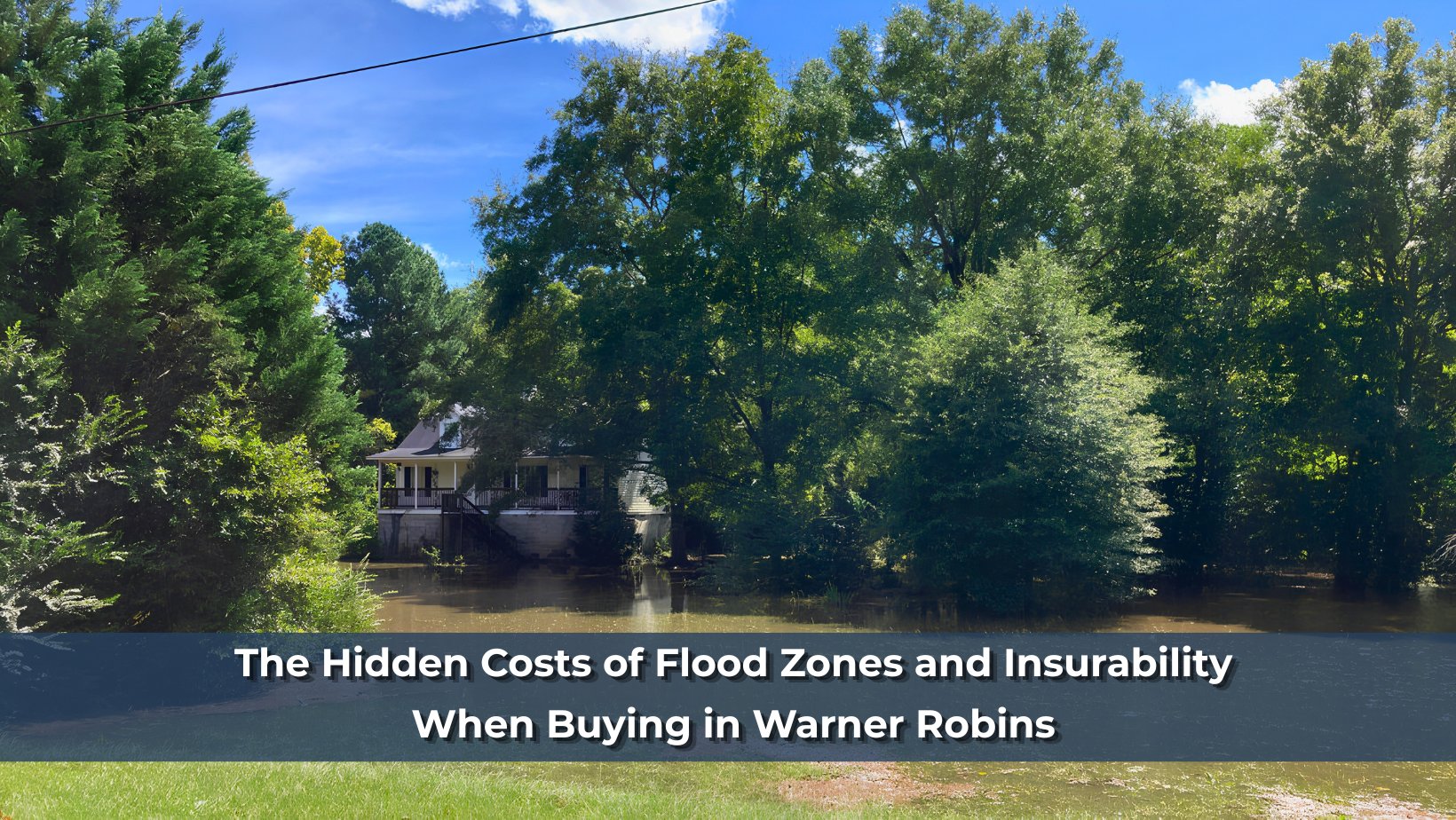
Two of the most overlooked costs in a Warner Robins purchase never show up on the listing and rarely come up until late in the process: whether the home sits in a flood zone, and whether it can be insured at a reasonable price. Both can add hundreds or thousands of dollars a year, and both can end a deal entirely if they surface at the wrong time.
These are not obscure concerns. Georgia has seen major weather events in recent years, inland flooding from heavy rainfall is a real Middle Georgia risk, and the Georgia homeowners insurance market has tightened considerably. A buyer who checks the flood map and gets an insurance quote in the first week of a contract is in a strong position. A buyer who assumes both will be fine and finds out otherwise three weeks in is not.
Flood Zones: What They Are and What They Cost
FEMA maps flood risk across the country using Flood Insurance Rate Maps, and every property falls into a zone. The zone determines whether flood insurance is required and heavily influences what it costs.
Flood Zone | Risk Level | Insurance Implication |
AE (and other A zones) | High, 1% annual chance (100-year floodplain) | Flood insurance generally required with a federally backed mortgage |
X (shaded) | Moderate, 500-year floodplain | Not required but recommended |
X (unshaded) | Low | Optional, but still advisable |
V / VE | Very high, coastal wave action | Not applicable inland; relevant on the coast |
The most important and most misunderstood fact about flood risk is this: standard homeowners insurance does not cover flood damage. Flood is a separate policy, purchased through the National Flood Insurance Program or a private flood insurer, and an NFIP policy generally carries a 30-day waiting period before it takes effect. You cannot buy it the week a storm is forecast, and you cannot add it at the closing table as an afterthought.
What flood insurance costs in Georgia
NFIP flood policies in Georgia average roughly $832 per year according to FEMA data, though the figure varies widely by property. Inland lower-risk homes often pay $400 to $600, and one 2026 analysis of real Georgia quotes found a median around $530, with most falling between $250 and $700. Under FEMA's Risk Rating 2.0 pricing, your premium depends on your property's distance to water, elevation, foundation type, replacement cost, and the specific kind of flooding it faces, not just its zone.
Here is the point buyers miss most: from 2014 to 2024, nearly one-third of NFIP claims nationally came from properties outside high-risk zones. Being in an X zone means flood insurance is not required, not that flooding cannot happen. Middle Georgia's flood risk is driven largely by heavy rainfall and drainage, which does not respect the 100-year floodplain line, and a Preferred Risk Policy for a lower-risk property often starts around $400 to $600 a year, which is inexpensive protection for a real risk.
Drainage: The Flood Risk That Is Not on the Map
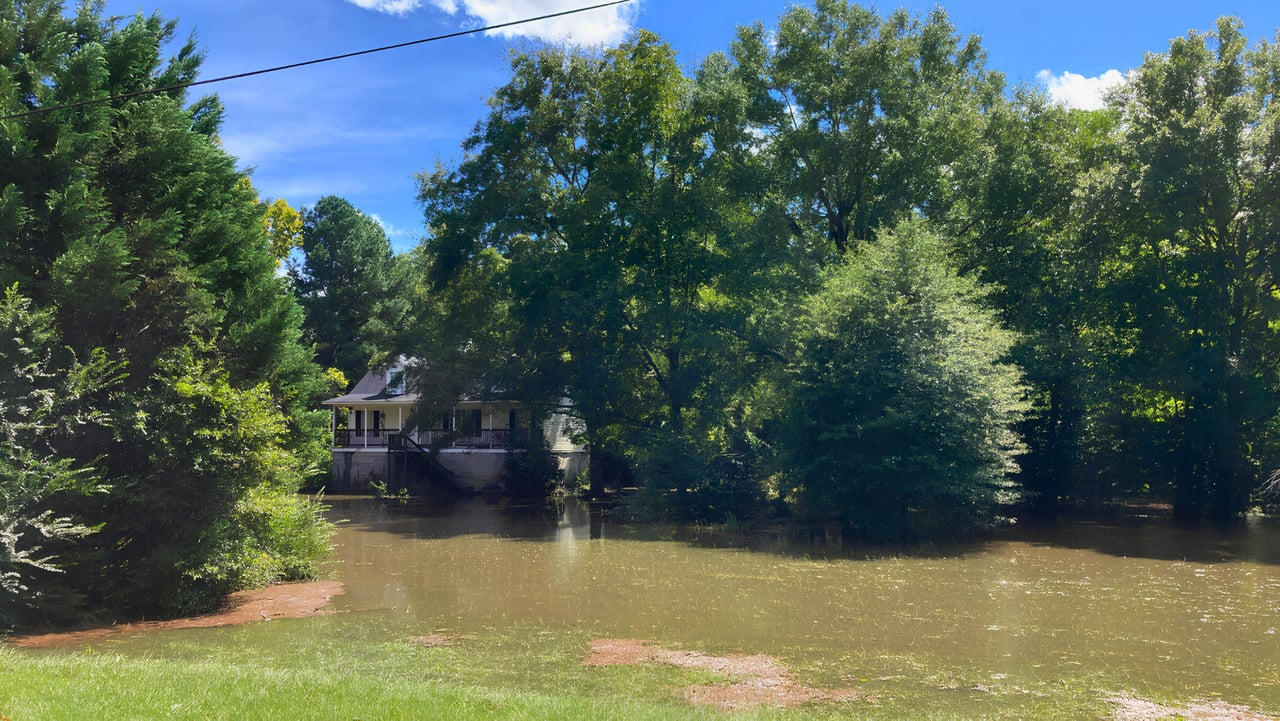
Flood maps capture floodplains. They do not always capture the local drainage problems that cause the most common water damage: a lot that sits low relative to its neighbors, a yard that sheds water toward the foundation, a poorly graded new subdivision, or a creek or ditch that backs up in a heavy Middle Georgia downpour.
These are hidden costs because they are invisible on a sunny showing day. When you tour a home, look for the signs: water staining in the garage or on the lower walls, a sump pump (which tells you the previous owner had a reason to install one), erosion channels in the yard, a foundation that sits low relative to the street, and mulch or soil washed against the house. Ask the seller directly whether the property has ever taken on water, and take a low-lying lot seriously even if it is technically in an X zone.
Insurability: The Cost That Can Kill the Deal
Separate from flood, the broader question of whether a home can be insured at a reasonable price has become one of the most consequential hidden costs in the Georgia market. Premiums have risen substantially in recent years, and carriers have tightened what they will write, which means insurability is no longer something a buyer can take for granted.
Roof age is the number that decides it
Roof age is the single most heavily weighted factor in Georgia homeowners underwriting right now. On an older Warner Robins home, an aging roof can raise your premium sharply or, in some cases, make a competitive policy difficult to secure at all. Because a home you cannot insure is a home you cannot finance, an uninsurable roof is functionally a deal-killer, and it tends to surface after inspection when your leverage is at its lowest.
Wind and hail deductibles are not what buyers expect
Many Georgia policies apply a separate wind and hail deductible expressed as a percentage of the dwelling coverage rather than a flat dollar amount. On a $300,000 home, a 2% wind and hail deductible is $6,000 out of pocket before coverage begins on a storm claim, which is very different from the $1,000 flat deductible many buyers assume applies to everything. Reading the deductible structure, not just the premium, is part of understanding the real cost.
The home's claims history follows it
Insurers check the CLUE report, a claims history database, on both the buyer and the property. A home with multiple recent water or storm claims can be more expensive to insure or harder to place, regardless of who is buying it. A buyer can request insight into a property's loss history, and a pattern of claims is worth understanding before you commit, because it becomes your premium once you own the home.
For Buyers: How Do I Protect Myself From These Costs?
Check the flood zone before you write the offer. Look the address up through the Georgia Flood Map Program, which lets you enter a property and see its FEMA zone in minutes. If the home is in an A zone and you are financing, budget for required flood insurance as a line in your monthly cost. If it is in an X zone, a low-cost Preferred Risk Policy is still worth pricing, especially on a low-lying lot.
Get an insurance quote in the first week of your contract, not the last. On an older home in particular, call an insurance agent early with the actual address, the roof age, and the home's details, and get a real quote. If the roof makes the home hard to insure, you want to know while you still have the option to negotiate a roof replacement, a credit, or an exit, rather than discovering it days before closing when the premium blows up your budget or the carrier declines outright.
Read the deductible, not just the premium. Ask specifically about the wind and hail deductible and whether it is a flat dollar amount or a percentage of dwelling coverage. A cheap premium with a 2% wind and hail deductible can cost you far more in an actual storm than a slightly higher premium with a flat deductible.
Walk the lot with drainage in mind. Look for the low-lying signs, ask the seller directly about past water intrusion, and remember that the flood map does not capture every drainage problem. A home that has flooded from poor grading will often flood again, and that is a cost and a headache no premium fully covers.
For Sellers: How Do Flood and Insurance Issues Affect My Sale?
If your home is in a flood zone, that fact will surface in the buyer's process, so it is far better to know it and address it in your marketing than to have it emerge as a surprise that shakes buyer confidence. A buyer who learns about a flood zone from their lender mid-contract reacts very differently than one who knew and priced it in from the start.
Roof age is the item most within your control. In the current market, a buyer whose carrier will not competitively insure your roof will renegotiate or walk, and that conversation lands after inspection when your position is weakest. Knowing your roof's age, having documentation of any recent replacement, and understanding how it affects insurability before you list is straightforward preparation that prevents a late-stage collapse. If your home has a clean claims history, that is a quiet asset worth knowing, because the CLUE report works in your favor as well as against it.
The Bottom Line
Flood risk and insurability are the two hidden costs in a Warner Robins purchase that are easiest to overlook and among the most capable of derailing a closing. Standard homeowners insurance does not cover flood, high-risk zones require separate coverage that cannot be bought at the last minute, and even outside those zones the insurance question, driven heavily by roof age, now shapes both what you pay and whether some financing works at all.
Check the flood map and get a real insurance quote in your first week under contract. Both take minutes, both cost nothing to investigate, and both turn a potential last-minute crisis into a known quantity you can plan around or negotiate over.
Frequently Asked Questions About Flood Zones and Insurability in Warner Robins, GA
Q: Is Warner Robins, GA in a flood zone?
A: Warner Robins and Houston County contain a mix of flood zones, and the correct answer depends entirely on the specific address. Most homes sit in low-risk X zones, but properties near creeks, drainage corridors, and low-lying areas can fall into higher-risk A zones such as AE. The only reliable way to know is to look up the exact address through the Georgia Flood Map Program or FEMA's Flood Insurance Rate Maps before making an offer. A property's flood zone determines whether flood insurance is required with a federally backed mortgage and heavily influences what that coverage costs.
Q: Does homeowners insurance cover flood damage in Georgia?
A: No. Standard homeowners insurance does not cover flood damage anywhere, including Georgia. Flood coverage is a separate policy purchased through FEMA's National Flood Insurance Program or a private flood insurer. NFIP policies generally carry a 30-day waiting period before coverage takes effect, which means flood insurance cannot be purchased at the last minute or in response to an approaching storm. Because nearly one-third of NFIP claims nationally from 2014 to 2024 came from outside high-risk zones, flood coverage is worth considering even when it is not required by your lender.
Q: How much does flood insurance cost in Georgia?
A: NFIP flood insurance policies in Georgia average roughly $832 per year according to FEMA data, but the figure varies widely by property. Inland, lower-risk homes often pay $400 to $600 per year, and one 2026 analysis of real Georgia quotes found a median around $530, with most falling between $250 and $700. Under FEMA's Risk Rating 2.0 system, premiums are based on the property's distance to water, elevation, foundation type, replacement cost, and flooding type rather than the zone alone. Preferred Risk Policies for lower-risk properties often start around $400 to $600 annually.
Q: Do I have to buy flood insurance in Warner Robins?
A: You are generally required to carry flood insurance if the home is in a FEMA high-risk flood zone, an A or V zone such as AE, and you are financing it with a federally backed mortgage. If the home is in a moderate or low-risk X zone, flood insurance is not required but is often still worth carrying, particularly on a low-lying lot, because Middle Georgia's flood risk from heavy rainfall and drainage does not respect the floodplain line. A low-cost Preferred Risk Policy is inexpensive protection against a real and underappreciated risk.
Q: Why is homeowners insurance so hard to get on older homes in Georgia?
A: The Georgia homeowners insurance market has tightened considerably, with premiums rising substantially in recent years and carriers becoming more selective about what they will write. Roof age is the single most heavily weighted factor in underwriting, so an aging roof on an older Warner Robins home can raise premiums sharply or make a competitive policy difficult to secure. Older electrical systems and certain recalled panel brands can also complicate coverage. Because a home that cannot be insured cannot be financed, insurability has become a genuine hidden cost that is worth checking early with a real quote.
Q: What is a wind and hail deductible?
A: Many Georgia homeowners policies apply a separate deductible for wind and hail damage that is calculated as a percentage of the dwelling coverage rather than a flat dollar amount. On a $300,000 home, a 2% wind and hail deductible means $6,000 comes out of your pocket before coverage begins on a storm-related claim, compared with the $1,000 flat deductible many buyers assume applies to everything. This structure matters a great deal in a state with frequent severe thunderstorms and hail, so it is important to read the deductible terms, not just the premium, when comparing policies.
Q: What is a CLUE report and why does it matter?
A: A CLUE report is a claims history database that insurers check on both the buyer and the property when writing a homeowners policy. Because the property's own loss history follows it regardless of who owns it, a home with multiple recent water or storm claims can be more expensive to insure or harder to place. A buyer can seek insight into a property's loss history during due diligence, and understanding a pattern of claims before committing is valuable, because that history becomes part of your premium the moment you own the home.
Q: How do I check the flood zone for a specific address in Warner Robins?
A: Use the Georgia Flood Map Program, which lets you enter any Georgia address and see its FEMA flood zone designation, or search FEMA's Flood Insurance Rate Maps directly. Both are free and take only a few minutes, and both should be done before you make an offer rather than after you are under contract. Knowing the zone tells you whether flood insurance will be required with a federally backed mortgage, gives you a basis to budget for the premium, and flags whether a low-lying property warrants extra scrutiny of its drainage even if it sits in a low-risk zone.
Q: Can drainage problems cause flooding even outside a flood zone?
A: Yes, and this is one of the most overlooked costs in a home purchase. FEMA flood maps capture floodplains, but they do not capture local drainage issues such as a low-lying lot, poor grading that sheds water toward the foundation, or a creek or ditch that backs up in a heavy downpour. These problems cause common water damage and are invisible on a dry showing day. Warning signs include water staining in the garage or on lower walls, a sump pump, erosion channels in the yard, and soil washed against the house, all of which are worth looking for and asking the seller about directly.
Q: Should I get an insurance quote before buying a home in Warner Robins?
A: Yes, and you should do it in the first week of your contract rather than the last. Call a licensed insurance agent with the actual address, the roof age, and the home's details, and get a real quote early, especially on an older home. If the roof or another factor makes the home difficult or expensive to insure, you want to know while you still have the leverage to negotiate a repair, a credit, or an exit. Discovering an insurability problem days before closing can blow up your monthly budget or, in the worst case, cost you the financing entirely.
Q: Does being in a flood zone lower a home's value in Houston County?
A: A high-risk flood zone designation can affect both marketability and cost, because it adds a required insurance premium for financed buyers and narrows the buyer pool to those comfortable with the risk and the expense. That does not make such homes unsellable, but it does mean the flood status should be understood and priced in from the start rather than surfacing as a surprise. For sellers, disclosing and addressing the flood status up front preserves buyer confidence, while for buyers, a flood zone is a real recurring cost to factor into the offer, not just a formality.
About the Author
William Walton-Dean is a licensed REALTOR® with Walton Dean Realty, operating under Real Broker LLC, serving buyers and sellers across Houston County, Georgia, including Perry, Warner Robins, Bonaire, Kathleen, Byron, and the surrounding Middle Georgia housing market. Known for a data-driven, hyper-local approach and deep expertise in the military and PCS relocation market around Robins Air Force Base, he helps buyers and sellers at every price point make clear, confident decisions backed by real market insight.
📱 478-371-7069
Walton Dean Realty | Real Broker LLC
Worried About Flood Risk or Insurance on a Warner Robins Home? Let's Check It Early
The flood line and the insurance quote are quick to check and expensive to ignore. Reach out with an address and we will pull the FEMA zone, flag any drainage concerns, and help you line up a real insurance quote in your first week under contract, while you still have room to negotiate.
William Walton-Dean | Walton Dean Realty
📱 478-371-7069
A More Strategic Approach to Real Estate
This article is provided for general informational purposes only and reflects FEMA program rules, 2026 Georgia insurance data, and market conditions as of July 2026. It is not insurance, lending, tax, or legal advice. Flood zone determinations, insurance eligibility, deductible structures, and premiums are set by FEMA, individual insurers, and property-specific underwriting, and are subject to change. Confirm flood zone status through the Georgia Flood Map Program or FEMA, and obtain quotes and coverage details from a licensed insurance agent for any specific property. William Walton-Dean is a licensed REALTOR® in the State of Georgia with Walton Dean Realty, operating under Real Broker LLC.