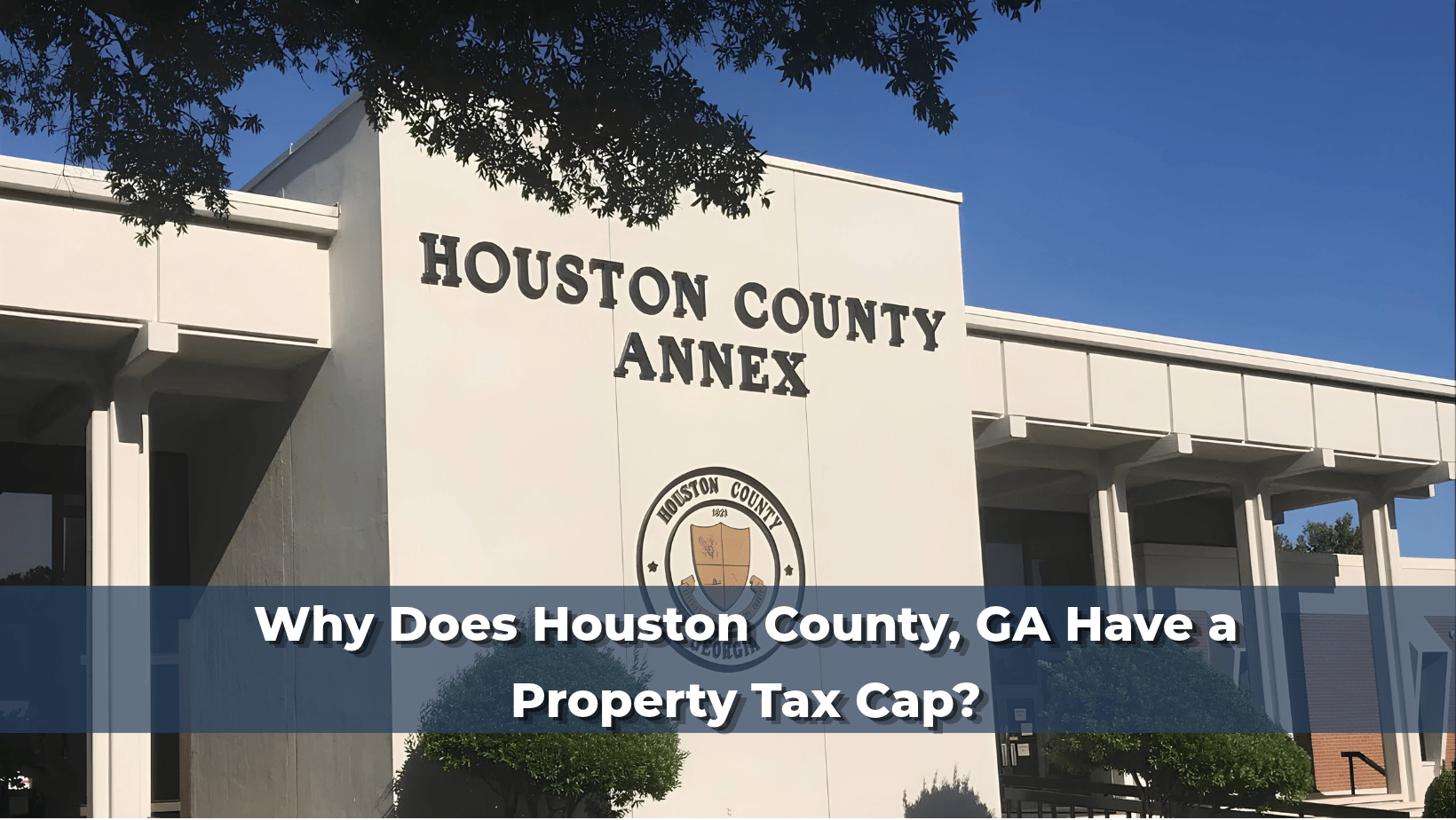
Houston County, Georgia's county government collects property taxes under a limit that most other Georgia counties do not have. According to the Board of Commissioners' own millage presentations, two permanent decisions made by Houston County voters in 1982 shape the county's rate every year: the county's Local Option Sales Tax penny goes to the Board of Education rather than to county government, and the county operates under a tax cap, a local constitutional amendment that limits the growth of the taxes the county collects. The county's SPLOST FAQ states the same thing from the other direction, that Houston County has a tax cap that limits the millage rate regardless of whether SPLOST is in effect. Those two decisions are why the Board of Commissioners proposed 8.45 mills for 2025 as its fourth consecutive reduction and what it called a historically low rate, and why it proposed 8.419 mills for 2026, even as the county's tax digest and population have grown.
This guide explains what the county says the cap does, how it interacts with Georgia's rollback rate and Truth in Taxation rules, why the 1982 sales tax decision matters as much as the cap, what the arrangement means for the county's budget and for SPLOST, and what a homeowner or buyer should take from it. It describes the cap as the county describes it in its public materials; the amendment's exact mechanism is a matter of its text, which the county attorney can provide.
What the County Says the Cap Does
Each summer, when the Board of Commissioners presents its proposed millage rate, it opens with the same two sentences. The county's 2025 budget presentation states: two permanent decisions made by Houston County voters in 1982 affect our millage rate. The LOST collected in Houston County goes to the School Board, not the local government. We operate under a tax cap, a local constitutional amendment which limits the growth of the taxes collected. The presentation goes on to propose 8.45 mills, which it says will continue to reduce the millage rate for the fourth year in a row and be a historically low millage rate for Houston County, and it includes a table comparing Houston County's revenue per capita to other counties as evidence of what it calls the county's efficiency.
The county's SPLOST FAQ adds the practical consequence: Houston County has a tax cap that limits the millage rate, regardless of whether SPLOST is passed or not, so having SPLOST in effect means capital projects can be completed and not having it means they will not be, because the funding is not covered by other taxes such as property taxes. In other words, the county presents the cap as a ceiling on what it can raise from property owners, with the result that growth in services and capital projects has to come from the digest growing, from fees, and from the voter-approved SPLOST rather than from a higher rate.
Why the 1982 Sales Tax Decision Matters as Much as the Cap
Most Georgia counties levy a 1 percent Local Option Sales Tax whose proceeds go to the county and its cities for general operations, with the law requiring the proceeds to be used to roll back property taxes. Houston County's voters sent that penny to the Board of Education in 1982, so the Houston County School District receives a permanent sales tax that other districts do not, and the county government does not. That is a large part of why the school district could adopt an 11.677-mill rate for 2026, its lowest since 1992 and among the lowest of Georgia's 180 districts, while the county government, without that penny, operates its general fund on property tax within the cap plus fees and other revenue. Houston County's sales tax is 7 percent: 4 percent state, 1 percent LOST to the schools, 1 percent Education SPLOST and 1 percent county SPLOST, the last of which can fund only capital projects.
The contrast with Macon-Bibb is instructive. The consolidated government there receives its LOST and an additional Other Local Option Sales Tax available to consolidated governments, and it has used sales tax to cut its property tax rate by about 53 percent since 2021. Houston County's county rate has fallen for consecutive years by a different route, under a cap and without a general sales tax penny, which is why the county's rate is low but its options for funding new services are narrower.
How the Cap Interacts With Georgia's Rollback Rules
Georgia's Truth in Taxation law requires every taxing authority to compute a rollback rate each year, the millage that would produce the same revenue on the current digest as the prior year's rate produced before reassessments, and to advertise a tax increase and hold three public hearings whenever it adopts a rate above the rollback. Houston County's cap does not replace that process; it operates alongside it. In 2025 the county's rollback rate was 7.60 mills, the board proposed 8.45 mills, and the county advertised an 11.18 percent increase over the rollback rate and held the required hearings before adopting the rate on August 26, 2025. The cap, as the county describes it, limits how much the total tax collected can grow, while the rollback rules govern how any increase above the rollback must be disclosed.
For 2026 the pattern repeated: the board proposed 8.419 mills, down from 8.45, which WGXA reported would increase property taxes by nearly 4 percent against the rollback because of digest growth, compared to the 9.4 percent increase the prior year. The county's homestead-exempt owners are also covered by the floating homestead exemption under House Bill 581, which the county's 2025 notice describes as designed not to allow a homeowner's taxes to rise faster than inflation and to shift the burden toward commercial, multifamily and industrial property; the county certified an estimated rollback rate in May 2025 to comply with that law.
Houston County's Revenue Structure at a Glance
Revenue source | Who receives it | Limit or rule | What it funds |
County M&O property tax | Houston County Board of Commissioners | 1982 local constitutional amendment tax cap; Truth in Taxation rollback rules | County operations: Sheriff, courts, public works, administration |
Fire millage | Houston County (unincorporated fire district) | Set annually with the M&O rate | Houston County Fire Department |
School M&O property tax | Houston County Board of Education | State 20-mill limit for school districts; rollback rules | School operations |
Local Option Sales Tax (1 percent) | Houston County Board of Education | Permanent; directed to schools by 1982 vote | School operations |
Education SPLOST (1 percent) | Houston County Board of Education | Five-year voter terms; capital only | School construction, technology, security, transportation |
County SPLOST (1 percent) | County and the three cities | Six-year voter terms; capital only | Roads, buildings, parks, equipment |
City millage | Warner Robins, Perry, Centerville | Set by each council; rollback rules | City operations including police and fire |
Fees and other revenue | County and cities | Set by ordinance | Water, solid waste, permits, court fees |
For Sellers: Is the Low County Rate a Selling Point?
It is, when it is stated accurately. The county government's rate has fallen for consecutive years and was described by the Board of Commissioners as the lowest in at least 40 years, the school rate is the lowest since 1992, and the county's sales tax is a penny below Macon-Bibb's. What the low county rate does not mean is a low total bill at every address: a Warner Robins home adds the city's 10-mill rate for 2026, an unincorporated home adds the fire millage, and every bill depends on assessed value, which resets at sale.
When buyers relocating from metro Atlanta ask me about taxes here, I give them the structure rather than a slogan: county rate under a cap, school rate held down by a sales tax penny that goes to the schools, a city or fire line depending on the address, and a 7 percent sales tax. That explanation holds up when they get the first bill, and the slogan version does not. For sellers, the practical takeaway is to put the actual bill in the listing package and to let the county's own millage history, which is public and easy to cite, speak for the trend. A listing that says taxes are low is an opinion; a listing that attaches the bill and the county's rate history is a fact.
For Buyers: What Does the Cap Mean for My Future Tax Bills?
The cap limits what the county government collects, not what you pay. Your county line can still rise when your assessed value rises, within the rollback rules, and your school, city and fire lines are set by other bodies under their own rules. The protection that most directly limits a homeowner's own bill is the floating homestead exemption, which the county has not opted out of and which moderates increases in a homesteaded property's taxable value after the first reassessment following a purchase.
What I tell buyers is to read the structure as a signal about how the county is run rather than as a guarantee about their bill. A county that has lowered its rate for consecutive years under a voter-imposed cap, funds its capital projects through a SPLOST the voters renew, and sends its sales tax penny to the schools is a county with a particular set of priorities, and those priorities have held across several boards. The budget tradeoff is also real: the county has fewer levers than Macon-Bibb when it needs new revenue, which is why services and capital projects depend on digest growth and SPLOST renewals. A buyer who understands that is not surprised when the SPLOST referendum comes around in 2029, and understands why it matters.
Frequently Asked Questions About Houston County's Tax Cap
What is the Houston County tax cap?
A local constitutional amendment, approved by Houston County voters in 1982 according to the Board of Commissioners' millage presentations, that limits the growth of the property taxes the county government collects. The county's SPLOST FAQ describes it as a tax cap that limits the millage rate regardless of whether SPLOST is in effect. The county cites it each year, along with the 1982 decision to send the Local Option Sales Tax to the schools, as the two permanent voter decisions that shape its millage rate. The amendment's exact mechanism is set out in its text, which the county attorney's office can provide.
Why does Houston County's sales tax go to the schools?
Because Houston County voters decided in 1982 that the county's 1 percent Local Option Sales Tax would go to the Board of Education rather than to county government, according to the Board of Commissioners' millage materials. That permanent penny, along with the voter-approved Education SPLOST, is a reason the Houston County School District adopted a 2026 rate of 11.677 mills, its lowest since 1992. The county government, without a general sales tax penny, funds its operations from property tax within the cap plus fees, and its capital projects from the county SPLOST.
What is Houston County's millage rate history?
The Board of Commissioners rolled the maintenance and operations rate back from 8.501 to 8.45 mills in 2025, which it described as the fourth consecutive reduction and, as far as its research showed, the lowest rate in at least 40 years, and it proposed 8.419 mills for 2026. In 2021 the rate was 9.935 mills, and in 2022 it was 9.81 mills before a proposed 9.56. The fire millage for the unincorporated county was raised from 1.177 to 1.677 mills in 2025. The adopted 2026 rates are published in the county's notices and local news coverage of the August vote.
Does the tax cap mean my property taxes cannot go up in Houston County?
No. The cap, as the county describes it, limits the growth of the taxes the county government collects in total. An individual bill can still rise with assessed value, within Georgia's rollback and Truth in Taxation rules, and the school, city and fire lines are set by other bodies. The floating homestead exemption under House Bill 581, which Houston County has not opted out of, is the provision that moderates increases in a homesteaded property's taxable value, and it applies after the first reassessment following a purchase.
How does Houston County fund new projects if its taxes are capped?
Through the county SPLOST, a 1 percent sales tax that voters renew in six-year terms for capital projects, most recently on November 7, 2023 for collection from October 1, 2024 through September 30, 2030, expected to raise $200 million. The county's SPLOST FAQ states that because the tax cap limits the millage rate, capital projects are completed only if SPLOST is in effect, since their funding is not covered by property taxes. Operating costs are funded from the capped property tax, fees and other revenue, and growth in the tax digest.
What is the rollback rate, and why does Houston County advertise a tax increase when it lowers the rate?
The rollback rate is the millage that would produce the same revenue on the current year's digest as the prior year's rate produced before reassessments. Georgia law requires any taxing authority adopting a rate above the rollback to advertise it as a tax increase and hold three public hearings. In 2025 Houston County's rollback rate was 7.60 mills; the county adopted 8.45 mills, lower than the prior year's 8.501 but above the rollback, so it advertised an 11.18 percent increase. The cap and the rollback rules operate together: one limits total collections, the other requires disclosure of any increase above the rollback.
Do the cities in Houston County have a tax cap?
The cap the Board of Commissioners cites applies to the county government's levy. Warner Robins, Perry and Centerville set their own millage rates under Georgia's rollback and hearing rules, and Warner Robins adopted a 10-mill rate for 2026 after a tie-breaking vote. The Houston County Board of Education sets the school rate, subject to Georgia's 20-mill limit on school districts, and the fire millage for the unincorporated county is set by the Board of Commissioners alongside its maintenance and operations rate.
How does Houston County's structure compare to Macon-Bibb's?
Macon-Bibb's consolidated government receives its Local Option Sales Tax plus an Other Local Option Sales Tax available to consolidated governments, for an 8 percent sales tax, and has used sales tax revenue to cut its property tax rate by about 53 percent since 2021 to 9.575 mills. Houston County's government operates under a 1982 tax cap without a general sales tax penny, at 8.45 mills in 2025 and a proposed 8.419 in 2026, with a 7 percent sales tax. Houston County's school rate, 11.677 mills, is lower than Bibb's 14.674 mills, helped by the LOST penny that goes to the schools.
Where can I read the Houston County tax cap amendment?
The Board of Commissioners describes it in its annual millage presentations and property tax notices, available on houstoncountyga.gov, and the county attorney's office can provide the amendment's citation and text. Georgia's local constitutional amendments adopted before the 1983 Constitution are compiled by the Association County Commissioners of Georgia in its published reference on local constitutional amendments. Homeowners with questions about how the cap is applied in a given year can raise them at the public hearings the county holds each summer before adopting its rate.
Does the tax cap affect my homestead exemption or the floating homestead exemption?
No. Homestead exemptions are set by state law and local acts and filed with the Houston County Tax Assessor by April 1, and the floating homestead exemption under House Bill 581 applies in Houston County because the county did not opt out. The cap limits the county government's total collections; the exemptions reduce the assessed value on which an individual homeowner's bill is calculated. Both work in the homeowner's favor, but they operate at different levels.
When does Houston County set its property tax rate each year?
In late summer. The Board of Commissioners certifies an estimated rollback rate in the spring, which it did in May 2025 at 8.501 mills to comply with the floating homestead exemption law, then proposes its rate in July, advertises any increase over the rollback, holds three public hearings in August and adopts the rate at a public meeting; in 2025 adoption came on August 26 and in 2026 the vote was scheduled for August 18. Tax bills reflecting the adopted rates are mailed before October 20 and due December 20.
About the Author
William Walton-Dean is a licensed REALTOR® with Walton Dean Realty, operating under Real Broker LLC, serving buyers and sellers across Houston County, Georgia, including Perry, Warner Robins, Bonaire, Kathleen, Byron, and the surrounding Middle Georgia housing market. He brings a data-driven, hyper-local approach to both residential and commercial transactions, working with first-time buyers, move-up sellers, investors, and families relocating to the area, including those tied to Robins Air Force Base. Drawing on a prior career as a C-level executive, he helps buyers and sellers at every price point make clear, confident decisions backed by real market insight.
📱 478-371-7069
Walton Dean Realty | Real Broker LLC
Buying or Selling in Houston County? Let's Talk.
If you want to understand what the tax bill on a specific Houston County home will look like after closing, or you are selling and want the county's tax structure explained accurately to buyers from out of the area, I will pull the lines for the address and walk you through them. I work with buyers and sellers across Warner Robins, Perry, Bonaire, Kathleen, Centerville and Byron.
William Walton-Dean | Walton Dean Realty
📱 478-371-7069
A More Strategic Approach to Real Estate
This article is provided for general informational purposes about Houston County, Georgia's property tax structure as described in the county's published materials and does not constitute tax, legal or financial advice. The county's tax cap is a local constitutional amendment whose operative terms are set by its text; millage rates are adopted annually by each taxing authority and may change. Consult the Houston County Tax Assessor, Tax Commissioner or county attorney for specifics. William Walton-Dean is a licensed REALTOR® with Walton Dean Realty under Real Broker LLC and is not a tax advisor or attorney.